There is a moment that separates collectors from investors who happen to own art.
It is not the size of the first acquisition. It is not the name of the artist. It is the moment when someone realises that the art market does not reward capital — it rewards relationships. And that without the right people around you, even the most substantial budget will consistently land you in the second tier of what is available.
The art market is not transparent. It is not meritocratic. It does not surface its best opportunities to the highest bidder. It surfaces them to the people it knows, trusts, and has chosen to include. Understanding this is not cynicism. It is the prerequisite for participating seriously.
The advisor: your most asymmetric relationship.
The right art advisor is not a researcher. They are not a stylist. They are not someone who accompanies you to fairs and tells you what looks good.
They are an intelligence network with a fiduciary bias toward your interests.
The art market trades heavily on inside information — which artist is about to move to a more significant gallery, who has an unannounced institutional show, which body of work is about to flood the secondary market and compress prices. None of this appears in a catalogue. None of it surfaces in a gallery visit. It moves through relationships built over years of genuine participation in the ecosystem.
The advisor who holds those relationships is, in effect, your access point to the market that actually matters. What to look for is not a credential or a famous client list. It is a track record of quiet, well-timed acquisitions made for collectors whose holdings you respect — and a way of operating that places your interests above their commission.
That combination is rarer than it sounds.
The gallery: a relationship, not a transaction.
Most investors approach galleries the same way they approach any vendor. They visit. They look. They ask for a price. They buy or they don't.
This is the wrong frame entirely — and it is why most investors end up with whatever was left after the people who mattered had already chosen.
Galleries allocate their most significant works based on trust built over time. They want to know where a piece is going. They want to know the collector is serious — that the work will be cared for, loaned to institutions when asked, and held with the long-term commitment that reflects well on the artist's trajectory. Arriving with a budget and no context gets you the inventory. It does not get you the conversation that precedes the inventory.
The collectors building meaningful collections today treat galleries as long-term partners. They attend openings not to buy, but to be present. They engage with programs out of genuine curiosity. They build relationships with directors long before they need anything from them. That investment of time is the real entry fee — and it cannot be shortcut with capital.
The specialist: the most underused relationship in collecting.
Most collectors engage auction house specialists at the moment of sale. The sophisticated ones engage them continuously, and for a different reason entirely.
The specialist who covers your area of interest sees everything. They see what is coming to market months before it appears. They know which estates are in motion, which collections are quietly being dispersed, which works have been passed privately before reaching the saleroom. They understand price history with a granularity that no database can replicate.
This is not information they share with strangers. It flows to people they know and trust — collectors who engage with genuine curiosity, who seek perspective rather than favors, who show up at previews not to bid but to learn. Positioning yourself inside that flow of information, rather than downstream of it, is one of the most underrated edges in the market.
The infrastructure no one wants to pay for — until they have to.
A collection built without proper valuation, legal structure, and provenance documentation is not a collection. It is a liability waiting to surface.
The most costly mistakes in collecting — disputed ownership, title issues, unexpected tax exposure at the moment of transfer — are not the result of bad acquisitions. They are the result of good acquisitions made without the right professional scaffolding in place. The appraiser, the art lawyer, the estate planner who understands collection-specific structures: these are not bureaucratic additions to a collection. They are the difference between a collection that transfers cleanly across a generation and one that becomes a protracted family dispute.
This infrastructure is unglamorous. It is also non-negotiable for anyone who is building seriously.
The network: the room you do not know you need.
The most serious collectors in the world are not solitary actors. They are embedded in networks of peers — other collectors at similar or more advanced stages, curators, trustees, artists — who collectively sharpen each other's judgment and expand each other's access.
This is not a social observation. It has direct consequences for the quality of what you can acquire. Galleries introduce collectors they trust to other galleries. Artists recommend collectors they respect to their own gallerists. Institutions open doors for collectors who are already inside the ecosystem. The network is not a luxury layer on top of the collection. It is the mechanism through which the best opportunities move.
What this means in practice.
Building a serious collection is not a capital deployment exercise with an aesthetic dimension. It is a relationship-building exercise that happens to involve capital — and one where the quality of the people around you determines the quality of what you can access.
The investors who get this right do not start by asking what to buy. They start by identifying who to build with — one advisor whose judgment they trust and whose access is real, one or two gallery relationships worth investing in over time, a specialist or two who will pick up the phone when something relevant surfaces.
The collection that follows reflects the quality of those relationships more than any other single variable.
The market will give you what your network can reach. The question is whether you are building the network deliberately — or leaving it to chance.
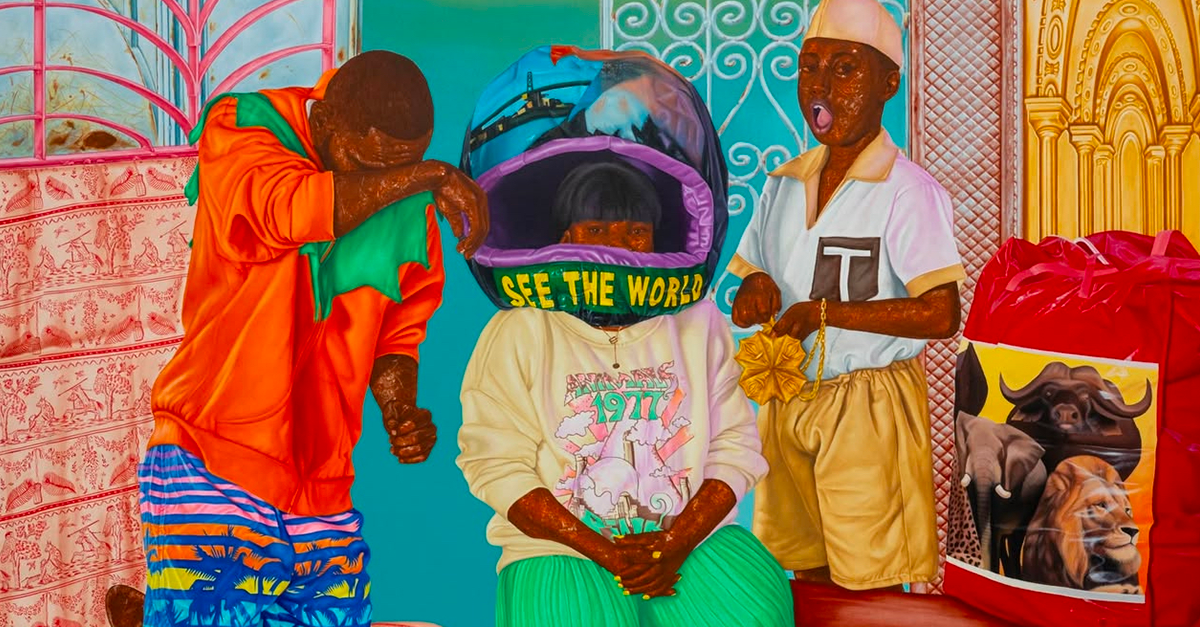
Artist showcased in this article cover : Hilary Balu
Title: Under the Mercator Sun (the Surface Dwellers), Year: 2025.
In this poignant work, Under the Mercator Sun (The Surface Dwellers), from his recent series Invisible Vestiges, Hilary Balu explores the paradox between global narratives of environmental conservation and the realities of resource extraction, land dispossession, and the disappearance of Indigenous communities in South Kivu, Democratic Republic of the Congo.The expulsion of the Batwa people from their ancestral lands—now designated as “protected areas”—has paved the way for the exploitation of both land and labor by foreign companies and NGOs. Under the pretext of ecological protection, a new form of domination takes shape. “Everything began by chance,” Balu recounts. “In the streets of Kinshasa, I found an old schoolbook titled This Wonderful World. Its once-innocent title now resonates with irony in a fractured Congo.”This rediscovered book became the guiding thread of Invisible Vestiges—a reflection on memory, history, and the ongoing sacrifice of the Congolese people and biodiversity on the altar of global progress.
At Moon Above, this is precisely what we do. We sit at the intersection of collecting, advising, and access — working with a small number of investors and family offices who are ready to engage with the market on its own terms. If that conversation is relevant to where you are, we are easy to find.